QIIME2 primer
What is QIIME2?
As described on the QIIME2 portal :
What is QIIME 2?
QIIME 2 is a powerful, extensible, and decentralized microbiome analysis package with a focus on data and analysis transparency. QIIME 2 enables researchers to start an analysis with raw DNA sequence data and finish with publication-quality figures and statistical results.
QIIME2 Overview
From https://docs.qiime2.org/2023.7/tutorials/overview/:
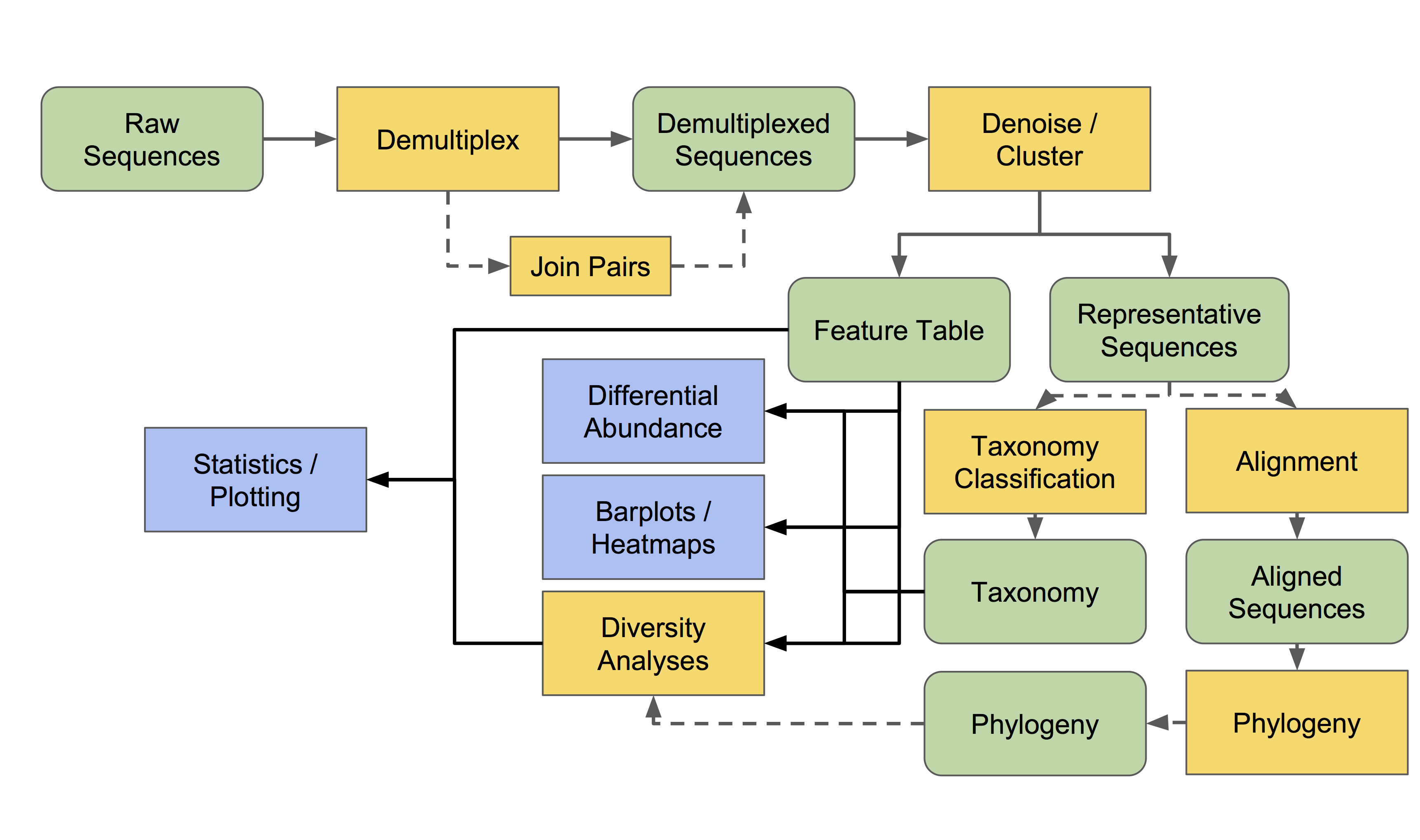
QIIME2 Artifacts
In QIIME2, we use “artifacts” instead of data files (e.g. FASTA files): these contain not only data but also additional information on the generation of the file itself. Therefore, before we start working with QIIME2, we need to import our data as a QIIME2 artifact.
Additional info: As described on the QIIME2 website (https://docs.qiime2.org/2023.7/concepts/):
“Artifacts enable QIIME 2 to track, in addition to the data itself, the provenance of how the data came to be. With an artifact’s provenance, you can trace back to all previous analyses that were run to produce the artifact, including the input data used at each step. This automatic, integrated, and decentralized provenance tracking of data enables a researcher to archive artifacts, or for example, send an artifact to a collaborator, with the ability to understand exactly how the artifact was created. This enables replicability and reproducibility of analyses, as well as generation of diagrams and text that can be used in the methods section of a paper. Provenance also supports and encourages the proper attribution to underlying tools (e.g. FastTree to build a phylogenetic tree) used to generate the artifact.”
Before we get started, let's briefly discuss the two main file types used with QIIME2. These are .qza files and .qzv files.
.qza - The QIIME2 artifact file. These contain data.
.qzv - The QIIME2 visualization file. These contain visualizations that can be viewed using QIIME 2 View.
In this course, we will mostly be using Qiime2view to visualise (instead of unzipping the qza file). You simply need to drag and drop the file of interest.